The Operational Blind Spots That Stall Growth
Growth problems rarely begin as revenue problems.
Most companies that hit a plateau are not suffering from a lack of effort, talent, or market demand. In fact, many are working harder than ever. Sales teams are active. Leadership is pushing initiatives. Marketing is generating activity. Operations are “busy.”
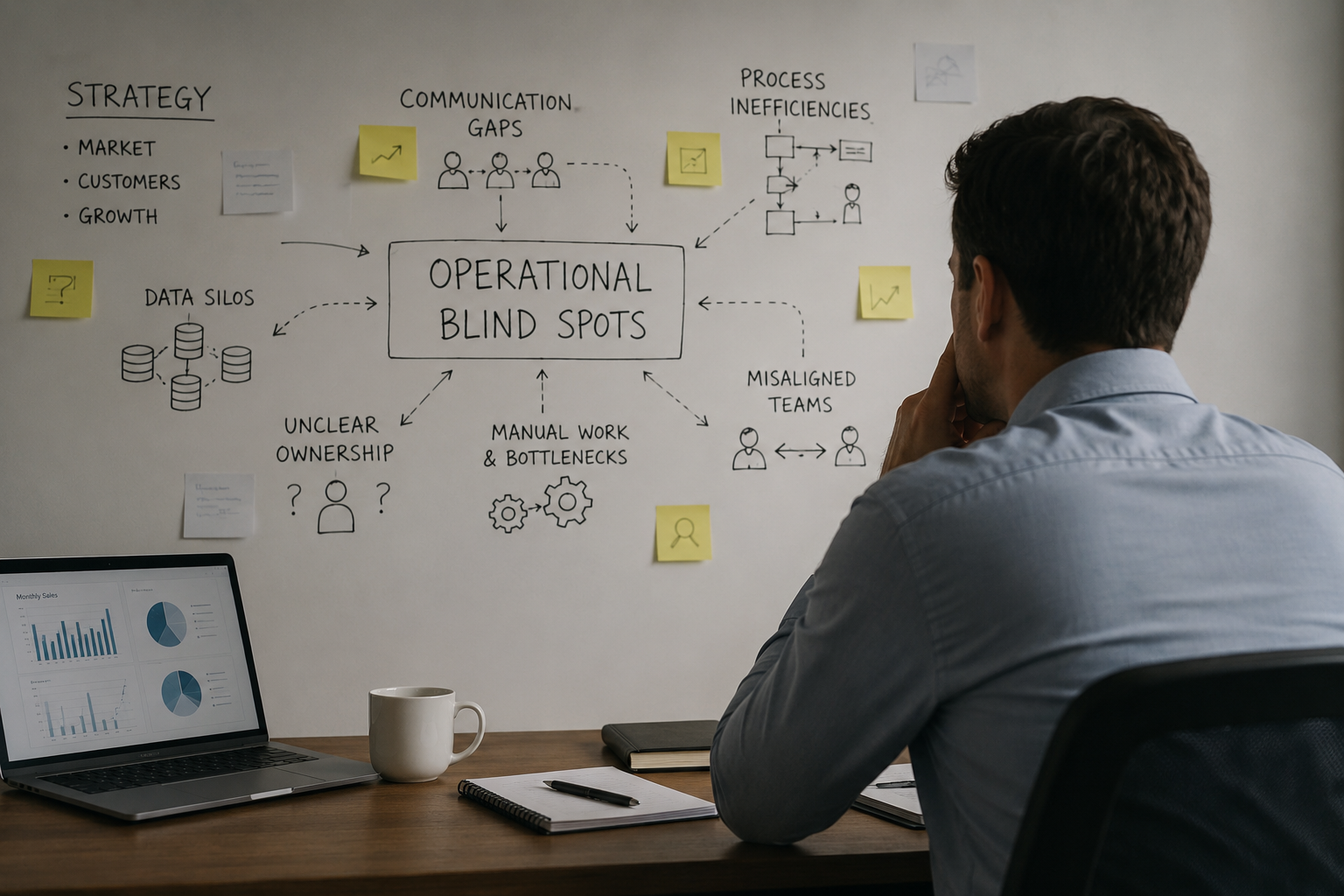
But underneath the visible momentum, there are often operational blind spots quietly limiting scale.
These issues usually do not appear dramatic at first. They show up as slower execution, inconsistent forecasting, declining accountability, or an increasing dependence on leadership intervention to keep things moving. Over time, they compound into missed revenue targets, margin pressure, team burnout, and stalled growth.
For small to mid sized businesses, especially those moving from founder-led growth into a more mature operating model, these blind spots are often the difference between a company that scales and one that stays stuck in complexity.
The Most Dangerous Problems Are Usually Invisible to Leadership
One of the challenges with operational inefficiency is that successful companies can absorb it for a long time.
Strong demand can temporarily hide weak processes. Talented employees can compensate for unclear systems. Leadership teams can manually solve issues through constant involvement.
But eventually, the business reaches a point where the organization itself becomes the bottleneck.
This is where executives often feel a disconnect between activity and results.
The company may be growing, but not efficiently. Revenue increases while profitability stagnates. Teams expand while execution slows. More meetings are added to solve communication problems that are actually process problems.
At this stage, many organizations misdiagnose the issue. They assume they need:
- More headcount
- More pipeline
- More software
- More marketing spend
- More sales pressure
In reality, they often need operational clarity.
Operational Debt Compounds Faster Than Financial Debt
Most leadership teams understand financial debt because the cost is measurable.
Operational debt is different. It accumulates quietly.
Every undocumented workflow, unclear ownership structure, disconnected system, or reactive process creates friction inside the organization. Individually, these inefficiencies seem manageable. Collectively, they create drag across every department.
The impact is rarely isolated.
A sales process issue affects forecasting.
Forecasting issues affect hiring decisions.
Hiring pressure affects onboarding quality.
Poor onboarding affects customer retention.
Retention issues create pressure on sales performance.
Eventually, the organization enters a cycle where teams spend more time compensating for internal inefficiencies than driving strategic growth.
This is why many businesses experience increasing operational complexity long before they experience meaningful scale.
The Leadership Bottleneck Is Often the Clearest Warning Sign
One of the most common indicators of operational blind spots is leadership dependency.
If executives must stay involved in every major decision, escalation, client issue, or internal process, the business has not truly operationalized growth.
Founder and executive involvement is valuable. Dependency is dangerous.
Many organizations unintentionally build operating structures around the strengths of a few key leaders instead of scalable systems. As the company grows, this creates a fragile environment where progress slows unless leadership is constantly pushing it forward.
The result is predictable:
- Decision making slows
- Cross functional accountability weakens
- Teams operate reactively instead of proactively
- Strategic initiatives stall during day to day operational pressure
- Leadership becomes consumed by management instead of direction
This is not usually a talent issue. It is a systems issue.
Strong operators understand that scalable growth requires reducing organizational dependency on individual heroics.
Growth Exposes Operational Weaknesses Faster Than Stability Does
Periods of rapid growth often create the illusion of organizational health.
In reality, growth tends to amplify operational weaknesses.
A process that works with 10 employees may fail completely with 40. A sales motion that succeeds with founder involvement may collapse when delegated across multiple teams. Communication structures that feel manageable in a small organization quickly become chaotic as layers are added.
This is why many companies experience operational strain immediately after periods of success.
The business did not suddenly become dysfunctional. Growth simply exposed the gaps that already existed.
Organizations that scale effectively tend to share a common characteristic: they treat operations as a strategic growth function, not a support function.
They recognize that sustainable growth depends on:
- Clear ownership structures
- Repeatable execution systems
- Cross functional alignment
- Reliable operational visibility
- Decision making frameworks that scale beyond leadership personalities
Without these foundations, growth becomes increasingly expensive and difficult to sustain.
Most Operational Problems Are Not Solved With More Activity
When performance slows, many organizations increase pressure instead of increasing clarity.
More meetings. More reporting. More initiatives. More oversight.
But operational friction is rarely solved through additional activity. It is solved through alignment, structure, and simplification.
This often requires leadership teams to step back and evaluate the business objectively:
Where are decisions slowing down?
Where are teams relying on tribal knowledge?
Where does accountability become unclear?
Which processes only function because certain individuals compensate for weaknesses?
What would break if the company grew 30% next quarter?
These questions are uncomfortable because they expose structural realities beneath surface level growth metrics.
But they are also where meaningful operational transformation begins.
Sustainable Growth Requires Operational Maturity
At a certain stage, growth stops being primarily about sales execution and starts becoming about organizational capability.
The companies that navigate this transition successfully are usually not the loudest or most aggressive in the market. They are the ones that develop operational maturity early enough to support long term scale.
That does not mean building bloated corporate structures or over engineering the business.
It means creating an operating environment where:
- Teams can execute consistently
- Leadership can focus on strategic direction
- Decisions move efficiently across the organization
- Growth does not create chaos
- The business becomes less dependent on constant intervention
Operational blind spots are rarely obvious from inside the organization. That is what makes them dangerous.
By the time the symptoms become impossible to ignore, the business has often already spent months or years absorbing avoidable inefficiency.
The organizations that scale most effectively are usually the ones willing to examine these gaps before growth forces the issue.